Welcome
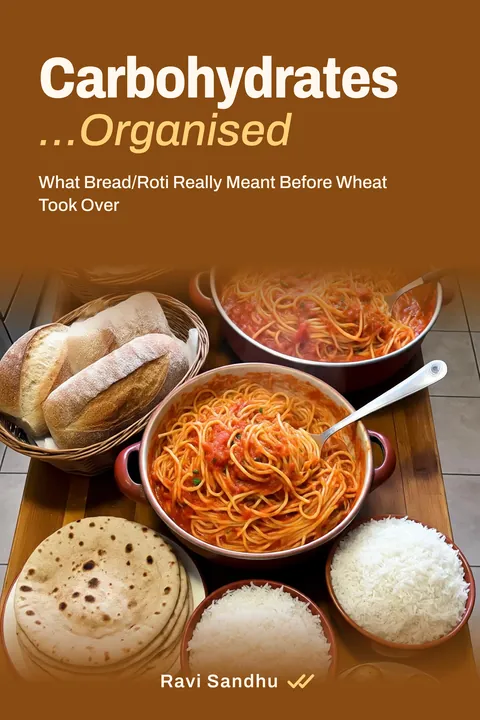
This is the audiobook of Carbohydrates… Organised. It is written for you, the person in your household who has decided to look properly at what the family eats, and to do something about it. In this series I call you the leader. That doesn't mean you are in charge of anyone. It means you are the one who has noticed something, and who wants to bring other people with you.
By the end of this audiobook, you will have a Todoist project set up, four stages to work through, and a clear idea of how to bring the cooks, the eaters and the elders in your family along with you.
Let me start with a memory.
When I was a boy, my massar ji, my mum's brother-in-law, used to call the playing children in to eat. "Batcha lok, aajo, roti karlo." Children, come and eat roti. More than once, I sat down and found no bread on the table at all. I laughed at him. "Massar ji, you said come and eat roti, but there's no roti!" I was sure I had caught a grown man, born in Punjab, in an obvious mistake.
I know now that he wasn't confused. I was. To him, roti didn't mean one particular flatbread. It meant the meal. Food. Sustenance. Whatever was keeping the family fed that day.
That small memory is the heart of this book. Somewhere in the last couple of generations, a word that meant "food" narrowed to mean one dish, made one way, from one grain: wheat. And for many households, especially households with South Asian heritage, wheat now appears at almost every meal. Nobody sat down and decided that. It simply became the thing nobody questions.
This book is about questioning it, gently. It is not about banning wheat. Wheat is a good food that has fed billions of people, and it has earned its place. The point is simpler. Being dominant is not the same as being the only sensible choice. A household that chooses its staples on purpose is better placed than one that simply defaults.
A word on what I am not. I am not a doctor, a dietitian or a nutritionist. I am a change practitioner who became curious about the food on his own family's plate. Nothing here is medical advice. Coeliac disease and wheat allergies are real medical conditions, and they belong with a clinician, not in this book.
The eBook goes much deeper into the history, the evidence and the reasoning. This audiobook gives you the method, so you can start.
Your Goal and New Identity
Every change needs a destination. Here is yours.
The goal. Your household sees how wheat came to dominate its plate, challenges that default, and eats a varied rotation of staples while keeping its food culture.
The new identity. Confident, curious eaters who choose staples on purpose rather than by default, without losing their cultural roots.
That identity matters more than any target. Targets fade. Identities hold. If your goal is "eat less wheat", you will feel deprived, and you will be waiting for the day you can stop. If your identity is "we are a household that chooses its staples on purpose", every meal is simply an expression of who you are.
Take the words in that identity one at a time.
Confident means being able to say, calmly, "we eat roti, and we also eat millet, rice and lentils, and we chose that." It doesn't need to win arguments with relatives, because it isn't trying to prove anything.
Curious means asking "what did my grandmother actually cook when she was young?" and "what does this grain taste like in our favourite dish?" Curiosity is also the cure for guilt. You can't be curious and ashamed at the same time.
Rooted is what makes the whole thing workable. A varied plate that costs a family its heritage won't last, and it shouldn't. The traditions you care about most stay exactly where they are. New staples earn their place by being cooked in the family's own spirit, with the family's own spices, for the family's own occasions.
What Being Organised Gives You
Being organised isn't about tidiness. It is about having the time, calm and confidence to lead your own life, and to bring other people with you.
For you, as the leader, it means planning varied meals ahead, instead of defaulting to the same staple at the last minute. It means less mental load, because the plan lives in one place. You can see what's working, which keeps you motivated. And you can share tasks, such as the shopping and the cooking, with clear expectations.
For the people who share your table, it means a say in what goes on the plate. Clear shopping lists. Fewer surprises. They know what's expected, and a shared project shows exactly where they can help. Their contribution is visible, and so is the difference it makes.
Everything Is an Organisation
Before we go further, one idea runs through this whole series. Everything is an organisation.
Your body is one. Different parts of your brain and body want different things, and getting them to pull in the same direction is most of what we call willpower. A marriage is an organisation. So are friends, parents and their children, a community, a company, a city and a country. Each has goals, roles, and a need to check whether things are working.
Science tells us that, left alone, things drift towards disorder. Physicists call it entropy. Living things survive by constantly maintaining their organisation. That is why I believe being organised is one of the most fundamental skills for all life on the planet. It isn't a trait you are born with. It's a set of skills you can learn, and the four Ds are those skills.
And being disorganised is rarely neutral. If you don't organise something that matters to you, something better organised usually fills the gap. In food, that something is the easiest, most heavily marketed default.
In this book, the organisations are the household, the kitchen and the food system. The humble roti sits where all three meet.
Setting Up Your Todoist Project
Now let's build the system. I use Todoist as the command centre for this change, so nothing important lives only in your head. The principles work with other apps too. If you already have a tool you like, use it.
If you are new to Todoist, I'd really appreciate it if you signed up through my affiliate link, which you'll find on this website. If my introducing you to Todoist helps you become more organised, using my link helps make all the effort I've put into these books worthwhile. Disclosure: this is an affiliate link, so I may earn a commission at no extra cost to you.
Step one. Create the project. Call it Organise Roti. That's the word you use at home, and it keeps the project grounded in your own food culture.
Step two. Add four stage tasks, in this order: Discovery, Dream, Design and Defend. These are the four Ds. Under each one, you'll add the smaller tasks I give you in the sections that follow.
Step three. Add the Staple Rotation Planner. Under Discovery, add a comment called the Staple Rotation Planner. This is where your weekly staple log goes during Discovery, and where your new rotation takes shape in Design. Use a comment rather than the task description, because the Habit Tracker writes into task descriptions.
Step four. Enable the Habit Tracker. Please switch on Todoist's Habit Tracker integration. You'll find it under Settings, then Integrations. Once it's on, you can open any recurring task, choose the three-dots menu, and pick Track habit. Todoist then keeps your streak. It belongs in the Defend stage, where you keep the new rotation going. Features change, so check Todoist's current help pages for the exact steps.
Step five. Write the six Cs at the top of the project description. You'll meet them later. They're a quick reminder to you, and to everyone you share the project with.
That's the system built. Now let's fill it.
The Four Ds
The four Ds are the method in every book in this series. They adapt the 4-D cycle from Appreciative Inquiry, developed by David Cooperrider and Diana Whitney, with process mining added to Discovery.
The core idea is simple. Compare the process people believe they run with the process the evidence shows they run. The gap between the two is where the change lives.
For food, the process is your household's meals. One case is one week of meals. The activities are: meal planned, staple chosen, ingredients bought, dish cooked, dish eaten. And the meals of past generations act as a historical record, a way of seeing what the plate looked like before today's default.
Let's take the stages one at a time.
Stage One: Discovery
Discovery is about seeing what's really on the plate, rather than what you assume is there. Then asking how it got there.
Start with what already works. Before you count problems, count the good things. Does your household cook from scratch most days? Do you eat together? Is there a dish everybody loves and nobody wants to lose? Write those down, and say why they work. That's solid ground to build from. It also reassures your family that you didn't begin from a verdict.
Keep a staple log for one ordinary week. For every meal, write down the staple: the base the rest of the meal sits on. Roti, rice, pasta, potato, bread, oats, noodles, or nothing. Don't change what you eat to make the log look better. The point is to see the default, not a performance of healthy eating.
Before you start, write down your guess. How often do you think wheat will appear? At the end of the week, count it up.
In my experience, one grain dominates far more heavily than people expect. For most households with South Asian heritage, that grain is wheat, as roti at most meals and often again as bread, pasta or a snack in between. The size of the gap between your guess and the count tells you how invisible the default has become.
A few things are easy to miss. Wheat hides in pasta, noodles, couscous, most breakfast cereals, and the batter on fried food. Many households eat more variety at the weekend and narrow back to the fastest option on busy weekdays, so the weekday number is usually the more honest one. And if more than one person cooks, notice whose night it is. That will matter later.
This isn't an invitation to feel guilty. It's simply switching the lights on in a room you've only ever walked through in the dark.
Ask what grandparents ate. Go back just a couple of generations in most South Asian families, and the log would have looked very different. Millet, maize, barley, sorghum and regional grains made up a much larger share of the plate. They weren't hard-times food. In many regions they simply were the staple. Ask your elders about the seasons, too. In Punjab, makki di roti with sarson da saag is the classic dish of the cold months, and millets such as bajra were often eaten in winter. You may find that "what we always ate" was really several diets, rotating through the year.
Trace how wheat won. Wheat's dominance isn't a conspiracy. It solved a genuine problem, very well, at the right time. After famine and war, the urgent need was clear: never let a population go hungry again. High-yield wheat breeding, later called the Green Revolution, combined with fertilisers, irrigation and machinery, produced far more food from the same land. Famine became, for much of the world, a solved problem. That's a real achievement, and it deserves to be named first.
In India, the same period concentrated subsidy, rationing and production on high-yielding rice and wheat. Millets became associated with poverty, and their share of the plate fell sharply. India has since led the United Nations' International Year of Millets, in 2023, and millets are coming back into school meals and markets.
But a modernisation built to solve one problem doesn't know when that problem has been solved. It keeps optimising for the same target, more calories, faster and cheaper, long after abundance has become the bigger issue.
Notice the dominant default. In my day job, helping organisations modernise, I see one pattern constantly. A single product becomes so completely the default that people stop seeing it as a choice. People call every search engine Google and every vacuum cleaner a hoover. I call this the Application Dominance Effect. Wheat has done the same to the idea of a staple. Ask many people what roti is, and they'll tell you it's a type of bread. That answer tells you less about roti than about how completely one grain has taken over the word.
Separate evidence from folklore. Once a food wins this completely, the conversation becomes about identity, and honest evidence gets harder to find. Here's the balanced position the eBook arrives at. Research suggests that wheat, particularly in energy-dense and refined products, plays a real role in modern weight gain. But it isn't a universal poison. Popular books claiming wheat causes almost every chronic disease go far beyond the evidence. And the folklore runs both ways. "Wholewheat is unprocessed, so it's fine" doesn't hold up, because all wheat we eat is milled and cooked.
Be careful with the word "carbs", too. Sugar, starch and fibre are all carbohydrates, and your body treats them very differently. When someone says "carbs are bad", ask which one they mean.
One more thing. Weight is complicated. Sleep, stress, genetics, medication, money, time and the food environment all play a part. In a small trial at the US National Institutes of Health, people offered ultra-processed food ate about 500 more calories a day than when they were offered unprocessed food. That's a signal, not a settled answer. But it shows why designing your environment works better than relying on willpower.
Notice the identity behind the food. Most resistance to changing roti isn't really about facts. The researcher Dan Kahan calls it identity-protective cognition: people process evidence in whatever way protects their place in a group they care about. When someone says, "You mean you're Indian, and you don't eat roti?", that isn't a factual correction. It's identity checking whether you still belong. Meeting it with more facts rarely helps. Compassion and patience usually get further.
Here are your Discovery tasks.
- Note what already works well, and why.
- List the staples in your household's meals.
- Count how often wheat appears each week.
- Record which grains past generations ate, such as millet, maize and barley.
- List the beliefs about wheat you grew up with.
- Collect health claims about wheat and its alternatives to fact-check.
- Identify meals where wheat is the default with no alternative considered.
- Separate evidence from folklore on health claims.
- Spot the identity reasons for sticking with wheat.
- Pick which meals to challenge first.
Stage Two: Dream
Dream is about setting out what success looks like, what it will take, and who's involved. Then you tell the people it affects.
Change projects stall when they only describe what people should stop doing. "Eat less wheat" has nothing on the other side of it. A dream gives people somewhere to go, instead of something to defend.
Write the identity in your own words. Take "confident, curious eaters who choose staples on purpose, without losing our roots", and say it your way. Then check every later decision against it. If a change makes your household anxious, secretive or ashamed, it needs another look.
Picture a varied week. Make the dream concrete enough to see on an ordinary Wednesday. Here is one illustration, not a prescription.
On Monday, lunch is a millet roti with dal, and dinner is wheat roti with the same dal. Millet is a good first swap because it goes well with familiar dishes. On Tuesday, dinner is rice with rajma, where the grain on the side was always a choice. Wednesday is a busy night, so the plan includes a quick pulao or khichdi, written in advance so a tired evening doesn't slide back to the default. On Thursday, the family tries one new thing, such as a maize roti, and notes what everyone thought. On Friday, wheat roti, because it's a deliberate choice, not an accident. And at the weekend, you cook the dish that carries the most meaning. If it's built on wheat, it stays built on wheat.
Notice what makes that week workable. It starts from your real numbers. If your log showed wheat at nine meals in ten, aim for seven or eight at first. It changes one thing at a time. It builds in slack. And it protects every festival dish and grandmother's recipe that anyone has called non-negotiable.
Be honest about time and cost. New grains take some trial and error. Who cooks, and how much time do they have? What does the shopping cost? Better to know now.
Name who needs to agree. The cook, the eaters, and the elders who shape family meals. A rotation that nobody agrees to cook is a wish list, not a plan.
Tell people early. When you only tell your household what's wrong with the current plate, you invite them to defend it. When you tell them who you hope to become together, and what's staying exactly as it is, you give them somewhere to move to.
Here are your Dream tasks.
- Write the new identity in your own words.
- Define what a varied plate looks like in twelve months.
- Estimate the time and cost of trying new staples.
- Name who cooks and who needs to agree.
- Decide which traditions are non-negotiable.
- Set a date to review.
- Communicate the dream to the household and the elders who shape family meals.
Stage Three: Design
Design is about how you want things to work, and the few changes that matter most.
Separate the dish from the ingredient. This is the most useful tool in the book. The word roti has been doing two jobs. One job is naming a dish: a wheat flatbread, cooked a particular way. The older job is naming a category: the staple, the food that keeps a household fed. Remember the old phrase "roti, kapada aur makaan", food, cloth and shelter, popularised by Indira Gandhi in the late 1960s and used as the title of a hit 1974 film. Kapada doesn't mean one garment. Makaan doesn't mean one house design. So it would be strange if roti meant one specific bread.
Once you separate the two meanings, much of the emotional charge simply drains away. You're not giving up the category: sustenance, a shared meal, a tradition of eating together. You're only reconsidering which grain fills that role this time.
Look back at your staple log. For each meal, ask: is the meaning I attach to this about the grain, or about the gathering, the ritual, the person who cooked it? Very little of it turns out to be about the grain.
Design a rotation. Now plan which staples appear when.
Start from the real numbers, not the aspiration. Small changes that stick beat ambitious ones that collapse in a fortnight.
Reintroduce what grandparents ate. For many households, millet, maize and barley aren't exotic health foods. They're a return to something that already belonged.
Keep the dish, change the ingredient, one at a time. Try a millet roti before redesigning the whole week.
Let the season lead, if you'd like to try it. One idea worth testing is a warm-months rotation and a cold-months rotation, built from what's naturally abundant where you live and what your tradition already pairs with each season. There's some interesting research suggesting the body has seasonal patterns, but I know of no trials comparing a seasonal diet with a fixed one, so treat this as an idea to try, not a proven benefit. If anyone in your household has diabetes or another medical condition, they should take advice from their clinician first.
Sort the list with MoSCoW. Your list of grains and dishes to try will soon hold more than you have time for. MoSCoW sorts it into four groups. Must have: without it, this round fails, such as protecting a festival dish. Should have: painful to drop, but survivable. Could have: nice, and the first to go. Won't have this time: parked, not forgotten. Keep the Musts to a minority of the effort. In Todoist, map them to priorities one to four, and review the parked items at the end of each round.
Watch your measures. In 1975 the economist Charles Goodhart noticed that when a statistic is used to steer policy, it stops behaving as it used to. The anthropologist Marilyn Strathern put it simply: when a measure becomes a target, it ceases to be a good measure.
Your planner invites counting: how many days this week included millet, maize or sorghum? That's useful. But if the count becomes the target, a family can hit it by forcing an unloved flour onto the table, or buying a token bag that never gets opened. So pair the count with two counterweights. Was the dish enjoyed? And did an elder help make or remember it? A rotation that hits the number but makes meals a chore has failed. A slower rotation that the family loves has succeeded.
Set an evidence standard. You'll hear health claims constantly. Ask what kind of study it is: a large human study, a small trial, an animal study, or just a confident opinion? Be wary of any claim that explains too much. Real findings are usually narrow and hedged. And ask who benefits from you believing it.
Plan for nutrients if your household eats little or no animal food. Many South Asian households already eat vegetarian meals. If yours eats no animal foods at all, vitamin B12 is the one to plan for, through fortified foods or a supplement. Vitamin D is worth considering in autumn and winter for most people in the UK. And make sure there's a reliable source of iodine. Ask a health professional about children and pregnancy.
Put the rotation into Todoist. Add each part of the rotation as a recurring task, such as "Cook a non-wheat staple dish" on the days you chose. In Defend, these are what the Habit Tracker counts.
Decide what would change your mind. Before you start, write down what you'd expect to notice if the rotation were working: enjoyment, energy, cooking time, cost, waste. And what would tell you it wasn't. Without that, it's easy to drift back without ever deciding to.
Here are your Design tasks.
- Choose alternative grains to test in familiar dishes.
- Separate each dish's cultural meaning from its ingredient.
- Set evidence standards for any health claim.
- Plan a varied weekly staple rotation, as recurring tasks.
- Adapt family recipes.
- Add a weekly "One millet meal" task, and a monthly task to try a grain your grandparents would recognise.
- Add a counterweight to every count in your planner: was the dish enjoyed, and who helped?
- If your household eats little or no animal food, add a nutrition plan.
Stage Four: Defend
Defend has two jobs. First, moving people. Then, keeping the change in place.
Expect a transition, not an event. William Bridges made a distinction that helps here. Change is an event. Transition is the psychological journey people go through in response. You can redesign a rotation in an afternoon. A household's sense of what it eats takes much longer to shift.
Bridges described three phases: an ending, a confusing neutral zone, and a new beginning. Ask ten people in your family what roti fundamentally is, and you may get several answers. The grandmother who rolled it by hand. The parent who bought it ready-made because modern life demanded it. The child who has only known the supermarket version. That's what the neutral zone sounds like. Someone defending the old default loudly may not be disagreeing with your evidence at all. They may still be standing in the ending, and no amount of data moves a person faster through that.
Treat elders as custodians, not obstacles. Grandparents who lived through real scarcity often see abundant wheat as a triumph, proof that the hard years are over. That isn't a factual error to correct. It's a true account of their life.
Be critical of systems, and generous to people. Supply chains, food policy and marketing are fair targets. Your grandmother serving you roti, generously and often, is not. She is doing exactly what her own mother did, with exactly the same love.
Involve elders in the design, rather than handing them a finished plan. Ask what they ate before wheat became the automatic answer. You'll often find the "alternative" you were about to suggest is, to them, a return to something they remember fondly and can cook far better than you.
Separate beliefs from values. The social psychologist Milton Rokeach distinguished values, the deep things we hold dear, such as health, family and belonging, from beliefs, the specific claims about how the world works. "We eat roti every day" is a belief about what good care looks like. The value underneath is "I want to feed my family well."
So affirm the value before you question the belief. Instead of "you're wrong about roti", try: "I know how much you want us to be well fed and healthy. Here's a rotation that gets us there a different way." That order is the difference between a conversation that goes somewhere and a standoff.
Apply it to yourself, too. If you feel oddly triumphant about having figured out the truth about wheat, check whether a belief has started doing the job of a value. The rotation is only your current best guess.
Introduce one alternative at a time. Give each new grain a fair trial. The first attempt is rarely the best, so agree a number of tries before anyone gives a verdict. Three is a good start.
Watch for drift. Left alone, a varied rotation drifts back to the easiest, most familiar option. That's entropy again, and it isn't a moral failure. The defence is simple. Repeat the staple log every few months and compare the numbers. Notice early, and the correction is small.
Watch for food's own straddlers, too. Products marketed as "ancient grain" or "artisan" may be made on the same industrial lines as everything else, wearing the language of tradition.
Use the Habit Tracker. Each time you cook a recurring staple task, you tick it off, and that tick is your check-in. The streak shows how well the rotation is holding. A reset shows where drift is starting. Treat a reset as information, not failure.
Treat setbacks as information. Nassim Nicholas Taleb uses the word antifragile for systems that get stronger under stress. An antifragile food culture treats a collapsed week, an ignored rotation at a family gathering, or a pointed comment about "forgetting where you came from" as data. Which part was weakest? Which occasion needed a different plan? Which relative needed a gentler conversation?
Set your cadence. Every organisation that lasts runs on a rhythm, and that rhythm is called cadence. Because things drift when left alone, cadence brings you back on track. For this project, that means a quick daily look at the day's cooking tasks, a weekly look at the week's meals, a monthly review of the rotation, and a seasonal review, roughly every three months, that also repeats the staple log. Set each one as a recurring task, and the rhythm takes care of itself.
Here are your Defend tasks.
- Introduce one alternative at a time.
- Involve elders as custodians of tradition.
- Use Bridges to let go of the default gently.
- Frame change around shared values, such as health and heritage.
- Share results with the wider family.
- Review the staple rotation monthly.
- Watch for drift back to the default.
- Keep a range of staples in the cupboard.
- Revisit choices as evidence changes.
- Review the rotation once a season, and repeat the staple log.
- Show children where their food comes from: a market visit, growing one vegetable, cooking a meal together.
The Six Cs
The four Ds are your method as the leader. The six Cs are different. They're the shared language that you and the people around you use while the change happens. Here's what each means for food, and how you can model it.
Compassion. Food carries memory and identity. Challenge the default without dismissing tradition. When your grandmother says "this isn't proper roti", thank her for caring about the food before you say anything else.
Communication. Say what you'd like to try, and give honest feedback on new dishes, early and in the agreed place, usually the shared Todoist project. Invite the same honesty back, including when a dish didn't work.
Capacity. Change one meal at a time, within your cooking time and budget. A tired parent on a weekday doesn't need a three-hour recipe, so put a quick option in the rotation on purpose.
Commitment. Give each alternative a fair trial before judging it. Do what you said you'd do, or say early if you can't.
Consideration. Elders, dietary needs and whoever cooks all have a say. If someone has a medical condition or an allergy, their needs come first and the plan bends around them. Ask the cook before the menu changes, not after.
Consistency. Keep the rotation going so the old default doesn't creep back. Tick off the monthly review, even when you'd rather skip it.
Leading Your People
You can't change a household's food on your own. The cooks, the eaters and the elders all shape what ends up on the plate.
There's a short companion called Carbohydrates… Organised: Support. It's written for them, not for you. It takes under ten minutes, and it explains the six Cs, what you'll ask of them, and how to use the shared project. Share it early, with a short personal note.
Then share your Todoist project. Invite whoever cooks, shops or shapes family meals. They can see the plan, add ideas, and tick things off. If someone isn't comfortable with apps, print the week's plan and put it on the fridge. The project is a tool, not a test.
Be specific about what you're asking. "Could you teach me how you made bajra roti when you were young?" is far easier to say yes to than "support me with this."
Model the six Cs yourself. If a new dish flops, say so lightly. It makes it safe for everyone else to be honest too.
And say thank you, often. Visible contributions deserve to be noticed.
Next Steps
Here's what to do next.
Today, create your Organise Roti project in Todoist, with its four stage tasks and the Staple Rotation Planner under Discovery. Switch on the Habit Tracker.
This week, start the staple log. Write down your guess first, then count for one ordinary week. It's the single most useful thing you can do.
This month, talk to an elder about what they ate when they were young, and try one familiar dish with a different grain.
Then keep going, stage by stage. Widening your household's plate isn't a project with an end date. It's a standing habit, because defaults regrow the moment attention is withdrawn.
For the full history of how one grain won, the evidence in detail, and the reasoning behind every stage, read the eBook of Carbohydrates… Organised.
If you're new to Todoist, I'd really appreciate it if you signed up through my affiliate link, which you'll find on this website. Disclosure: this is an affiliate link, so I may earn a commission at no extra cost to you.
Thank you for reading. Roti was always about the meal, and the people around it. Keep the people. Choose the grain on purpose.
Put it into practice
Take the free course for a four-lesson summary and a short assessment, then set up your Organise Roti project in Todoist.
This is my Todoist affiliate link. If you're new to Todoist, I'd really appreciate you signing up through this link rather than going to Todoist directly. It costs you nothing extra, I may earn a small commission, and it helps me keep creating these books and courses. Thank you.